
Bat Tiles in Buckinghamshire
Heritage Tiles: Emblematic of the finest craftsmanship
Heritage tiles are the professional roofer's choice for the highest quality clay roof tiles. We pride ourselves in manufacturing, stocking, and delivering the very finest in prestige clay roof tiles.
Heritage Tiles have several tile ranges that satisfy every architectural requirement. Vintage and historic properties right up to modern new builds are covered by the diverse range of clay roof tiles that we stock.
So, whether you are in the building trade, or simply wish to choose your own tiles, Heritage Tiles have the right product for your specific requirements.
What Heritage Tiles have to offer our customers?
- We offer specification and technical solutions to help you achieve the perfect build.
- We also offer expert design advice to all our customers.
- We are happy to engage in site visits with our clients.
- We have stockists and distributors throughout the United Kingdom to ensure that we can provide our expert service to a wider area.
- We can provide estimated quantities from plans supplied by our clients.
- We offer battening plans.
- We can deliver a standard and bespoke colour choice for our clay tile products.
- All our tiles are assessed and approved by Lucideon.
- We provide a nationwide delivery and collection service.
The ranges of clay roof tiles we supply.
The Clayhall Range of roof tiles:
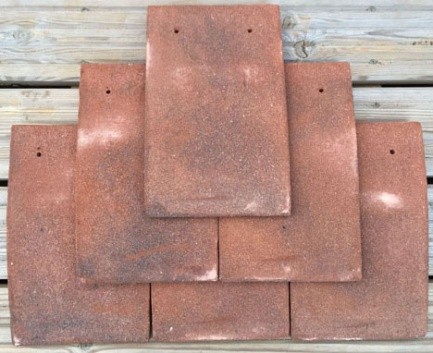
Clayhall Medium Blend - Carefully crafted to replicate all the features of handmade the Clayhall hand crafted range of tiles offers an excellent alternative when budget restrictions are a concern, but without compromising quality or durability.
Clayhall Dark Blend - Quality and durability in a budget clay roof tile. The Clayhall dark blend is sure to turn heads.
Clayhall Red Blend - A beautiful rustic clay roof tile. The Clayhall red blend is a firm favourite with our customers.
Clayhall Hamlet Mix - The Clayhall Hamlet mix is a gorgeous light and sandy looking clay roof tile that is a perennial favourite in the building trade.
Clayhall Birchwood Mix - The Clayhall Birchwood mix offers a gorgeous blend of lighter and darker shades in this diverse clay roof tile. If you are concerned that your roof tiles could look monotonous, the Clayhall Birchwood mix is the clay roof tile to choose.
The Conservation Range of roof tiles
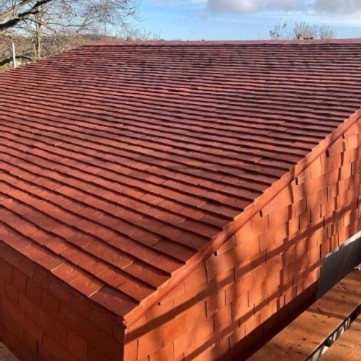
The Conservation range of roof tiles are available in a range of distinctive colours, created by using a very fine sand, The Conservation Weathered; A natural warm tone, achieving an instant mellow and settled look and The Conservation Red; perfect for vertical tiling especially suited for villages and hamlets with olde world vernacular charm.
Manufactured using high quality clay, achieving high strength and durability properties, giving homeowners and contractors peace of mind for many years to come. The conservation range comes with a complete set of associated fittings, including Hog Back Ridge, Half Round Ridge, Bonnet Hips, Valley tiles and External Angles.
The Conservation range of clay roof tiles comes in the following variations:
- Conservation Red
- Conservation Weathered
- Conservation Dark
Conservation Peg Tile
Plain clay roofing tiles laid to a double lap have been used for roof covering in England since before the Norman Conquest and tiles dating back to Roman Times have been discovered under excavation. From the outset clay plain tiles were made incorporating fixing features.
The Classic Edwardian roof tile
The Classic range of plain tiles is one of the finest ranges of clay tiles.
We source only the best raw materials for our craftsman to create beautifully handmade clay tiles of the highest quality and durability.
Tile Fittings available from Heritage Tiles
There are many fittings that are available from us a Heritage Tiles to complete your build to perfection. We stock and supply the following:
- Gable Tile
- Eave Tile
- Baby Porch Ridge
- 90 Degree Ext. Angle
- Universal Bonnet Hip
- Half Round Ridge
- Hogs Back Ridge
- Mono Ridge
- Third Round Ridge
- Universal Valley
- Ornamental Club
- Bat Tile Set
Bat Tiles:
Provide help for our bats with our range of bat friendly roof tiles.
Did you know that all UK bats and their roosts are protected by law? The Wildlife and Countryside Act introduced in 1981, gave legal protection to all bat species and their roosts in England.
Distinct species of bats prefer differing places to roost. The two most usually found species of bat in the UK are the Pipistrelle and Brown Long-Eared Bat. Pipistrelle prefer confined spaces such as under tiles on roofs and hanging spaces. The Brown Long-Eared Bat prefer roof timbers and ridges inside lofts. Heritage Clay Tiles can provide purpose made access points within your roof tiles or ridge tiles. The Bat Tile Set can form part of a mitigation package required by law for existing roosts or as potential access where a roost had not previously been present.
Select a Blend
Getting the right blend for your roofing project can feel daunting, but with our blend generator you can mix and match various blends of tiles to achieve the perfect blend.
Click here to make use of our online tool to choose your own unique blend.
Because our strict quality control provides a consistent tile size you can mix assorted styles and colours of tiles to make your roof unique to you. Please use the tool below to experiment with various blends.
Adjust the sliders to set the ingredients for your desired blend then click on the update mix button.
Alternatively click on any blend or tile to display it.
Whatever type of clay roof tile you want, Heritage Tiles will be able to help.
Bat Tiles
Bat droppings: Do not panic!
Some still show concern about having bat tiles installed as they are worried about the presence of bat droppings or urine and the potential for disease. This is often because they watched a documentary shot in a foreign country in a cave with hundreds and thousands of bats present. This number of bats and the chances of needing to wade through several feet of droppings in your attic would simply not happen in the United Kingdom.
In any case, the United Kingdom, the health risks from bat droppings are extremely low, especially when found in small, scattered amounts. The main potential risk, a fungus that can cause the respiratory disease histoplasmosis, is not even present in bats found on our shores or their droppings.
Where droppings can accumulate
More often than not, bat droppings accumulate underneath the roost, and below the points bats use to access a building or a roosting area, such as directly below bat tiles. All of our native bats feed on insects, so their droppings are made up of dried insect remains. Bat droppings are frequently mistaken for mouse droppings but unlike mouse droppings they do not contain any moisture and therefore they tend to crumble rather easily and look like they sparkle when crumbled.
Histoplasmosis is not a threat in the United Kingdom
Histoplasmosis is a disease caused by the fungus Histoplasma capsulatum, and it is not associated with bats found in the United Kingdom or their droppings. All cases diagnosed in the country have had clear travel links to endemic areas. In addition, Histoplasma spp. has never been recovered from the environment in general, of any bird guano specifically, in the United Kingdom.
Precautions to take with bats and bat tiles
On exceedingly rare occasions there are health risks from allergic reactions, such as dust inhalation when cleaning up exceptionally large quantities of droppings, and gastro-intestinal infection from consumption of droppings which may contain certain bacteria. However, remember that a few bat tiles in a roof will cause zero problems if they are merely external roost tiles for the bats, and even if the bat tiles act as an access point into a roof space, a few simple precautions are all that will be required to remain healthy and safe. Wearing a dust mask when clearing any droppings and maintaining basic standards of hygiene such as washing hands and clothing after the clean-up process.
Bat urine
The main issue with bat urine does not even relate to human health but the fact it contains high concentrations of uric acid which has been known to corrode certain metals. Bat urine also causes etching of polished surfaces and staining of light-coloured fabric and porous stone. However, not many people keep these items in a loft space, and certainly not directly below the access point of a bat tile.
Managing bat droppings and urine
Simple steps such as a layer of newspapers can be spread under the bat tiles or where their favourite roosting sites are within the attic, as this is where the majority of droppings and urine are likely to accumulate. Even then, the amount of fouling present in this country is negligible.
Always remember thought to only ever consider a clean-up operation when the bats are absent from the roost, which will usually be between September to April. Any droppings or fouled newspaper can be placed in the household refuse or added to compost, as the waste can be nitrogen rich, making it perfect for compost bins.
A little information about Buckinghamshire
Buckinghamshire is a county that borders Greater London to the south-east, Berkshire to the south, Oxfordshire to the west, Northamptonshire to the north, Bedfordshire to the north-east and Hertfordshire to the east.
Buckinghamshire is considered to be one of the Home Counties, meaning that it is one of the counties that surround Greater London. Towns such as High Wycombe, Amersham, Chesham and the Chalfonts in the east and southeast of the county are parts of the London commuter belt, forming some of the most densely populated parts of the county, with some even being served by the London Underground. Development in this region is restricted by the Metropolitan Green Belt. The county's largest settlement and only city is Milton Keynes in the northeast, which with the surrounding area is administered by Milton Keynes City Council as a unitary authority separately to the rest of Buckinghamshire. The remainder of the county is administered by Buckinghamshire Council as another unitary authority. Other large settlements include the county town of Aylesbury in the centre, the former county town of Buckingham in the northwest.
Buckinghamshire is a beautiful county
A large part of the Chiltern Hills, which is classed as an Area of Outstanding Natural Beauty, runs through the south of Buckinghamshire and attracts many walkers and cyclists from London. In this area older buildings are often made from local flint and red brick. Many parts of Buckinghamshire are quite affluent and like many areas around London this has led to high housing costs: several reports have identified the market town of Beaconsfield as having among the highest property prices outside London. Chequers, a mansion estate owned by the government, is the country retreat of the incumbent Prime Minister. Notable service amenities in the county are Pinewood Film Studios, Dorney rowing lake and part of Silverstone racetrack on the Northamptonshire border.
History of Buckinghamshire
The name Buckinghamshire is Anglo-Saxon in origin and means the district of Bucca's home. Bucca's home refers to Buckingham in the north of Buckinghamshire, and is named after an Anglo-Saxon landowner. Buckinghamshire has been so named since about the 12th century; however, the county has existed since it was a subdivision of the kingdom of Mercia from 585 to 919.
The history of Buckinghamshire predates the Anglo-Saxon period, and the county has a rich history starting from the Brythonic and Roman periods, though the Anglo-Saxons perhaps had the greatest impact on Buckinghamshire: the geography of the rural part of Buckinghamshire is largely as it was in the Anglo-Saxon period. Later, Buckinghamshire became an important political arena, with King Henry VIII intervening in local politics in the 16th century, and just a century later the English Civil War was reputedly started by John Hampden in Buckinghamshire.
Historically, the biggest change to Buckinghamshire came in the 19th century, when a combination of cholera and famine hit the county, forcing many local people to migrate to larger towns to find work. Not only did this alter the local economic situation, but it also meant a lot of land was going cheap at a time when the rich were more mobile, and Buckinghamshire became a popular rural idyll: an image it still has today. Buckinghamshire is a popular home for London commuters, leading to greater local affluence; however, some pockets of relative deprivation remain.
Products available from Heritage Clay Tiles Ltd in East Sussex
Clay Roof Tiles in East Sussex
Clayhall Roof Tiles in East Sussex
Conservation Peg Tiles in East Sussex
Conservation Roof Tiles in East Sussex
Edwardian Roof Tiles in East Sussex
Georgian Roof Tiles in East Sussex
Handmade Clay Tiles in East Sussex
Handmade Roof Tiles in East Sussex
High Quality Roof Tiles in East Sussex
Traditional Clay Tiles in East Sussex
Traditional Roof Tiles in East Sussex
Victorian Roof Tiles in East Sussex
Products available from Heritage Clay Tiles Ltd in Essex
Conservation Peg Tiles in Essex
Conservation Roof Tiles in Essex
High Quality Roof Tiles in Essex
Traditional Clay Tiles in Essex
Traditional Roof Tiles in Essex
Products available from Heritage Clay Tiles Ltd in Hampshire
Clayhall Roof Tiles in Hampshire
Conservation Peg Tiles in Hampshire
Conservation Roof Tiles in Hampshire
Edwardian Roof Tiles in Hampshire
Georgian Roof Tiles in Hampshire
Handmade Clay Tiles in Hampshire
Handmade Roof Tiles in Hampshire
High Quality Roof Tiles in Hampshire
Traditional Clay Tiles in Hampshire
Traditional Roof Tiles in Hampshire
Victorian Roof Tiles in Hampshire
Products available from Heritage Clay Tiles Ltd in Hertfordshire
Clay Roof Tiles in Hertfordshire
Clayhall Roof Tiles in Hertfordshire
Conservation Peg Tiles in Hertfordshire
Conservation Roof Tiles in Hertfordshire
Edwardian Roof Tiles in Hertfordshire
Georgian Roof Tiles in Hertfordshire
Handmade Clay Tiles in Hertfordshire
Handmade Roof Tiles in Hertfordshire
High Quality Roof Tiles in Hertfordshire
Traditional Clay Tiles in Hertfordshire
Traditional Roof Tiles in Hertfordshire
Victorian Roof Tiles in Hertfordshire
Products available from Heritage Clay Tiles Ltd in Kent
Conservation Peg Tiles in Kent
Conservation Roof Tiles in Kent
High Quality Roof Tiles in Kent
Traditional Clay Tiles in Kent
Traditional Roof Tiles in Kent
Products available from Heritage Clay Tiles Ltd in London
Conservation Peg Tiles in London
Conservation Roof Tiles in London
Edwardian Roof Tiles in London
High Quality Roof Tiles in London
Traditional Clay Tiles in London
Traditional Roof Tiles in London
Victorian Roof Tiles in London
Products available from Heritage Clay Tiles Ltd in Surrey
Conservation Peg Tiles in Surrey
Conservation Roof Tiles in Surrey
Edwardian Roof Tiles in Surrey
High Quality Roof Tiles in Surrey
Traditional Clay Tiles in Surrey
Traditional Roof Tiles in Surrey
Victorian Roof Tiles in Surrey
Products available from Heritage Clay Tiles Ltd in West Sussex
Clay Roof Tiles in West Sussex
Clayhall Roof Tiles in West Sussex
Conservation Peg Tiles in West Sussex
Conservation Roof Tiles in West Sussex
Edwardian Roof Tiles in West Sussex
Georgian Roof Tiles in West Sussex
Handmade Clay Tiles in West Sussex
Handmade Roof Tiles in West Sussex
High Quality Roof Tiles in West Sussex
Traditional Clay Tiles in West Sussex
Traditional Roof Tiles in West Sussex
Victorian Roof Tiles in West Sussex
Products available from Heritage Clay Tiles Ltd in Bedfordshire
Clay Roof Tiles in Bedfordshire
Clayhall Roof Tiles in Bedfordshire
Conservation Peg Tiles in Bedfordshire
Conservation Roof Tiles in Bedfordshire
Edwardian Roof Tiles in Bedfordshire
Georgian Roof Tiles in Bedfordshire
Handmade Clay Tiles in Bedfordshire
Handmade Roof Tiles in Bedfordshire
High Quality Roof Tiles in Bedfordshire
Traditional Clay Tiles in Bedfordshire
Products available from Heritage Clay Tiles Ltd in Berkshire
Clayhall Roof Tiles in Berkshire
Conservation Peg Tiles in Berkshire
Conservation Roof Tiles in Berkshire
Edwardian Roof Tiles in Berkshire
Georgian Roof Tiles in Berkshire
Handmade Clay Tiles in Berkshire
Handmade Roof Tiles in Berkshire
High Quality Roof Tiles in Berkshire
Traditional Clay Tiles in Berkshire
Products available from Heritage Clay Tiles Ltd in Buckinghamshire
Clay Roof Tiles in Buckinghamshire
Clayhall Roof Tiles in Buckinghamshire
Conservation Peg Tiles in Buckinghamshire
Conservation Roof Tiles in Buckinghamshire
Edwardian Roof Tiles in Buckinghamshire
Georgian Roof Tiles in Buckinghamshire
Handmade Clay Tiles in Buckinghamshire
Handmade Roof Tiles in Buckinghamshire
High Quality Roof Tiles in Buckinghamshire
Traditional Clay Tiles in Buckinghamshire
Products available from Heritage Clay Tiles Ltd in Cambridgeshire
Clay Roof Tiles in Cambridgeshire
Clayhall Roof Tiles in Cambridgeshire
Conservation Peg Tiles in Cambridgeshire
Conservation Roof Tiles in Cambridgeshire
Edwardian Roof Tiles in Cambridgeshire
Georgian Roof Tiles in Cambridgeshire
Handmade Clay Tiles in Cambridgeshire
Handmade Roof Tiles in Cambridgeshire
High Quality Roof Tiles in Cambridgeshire
Traditional Clay Tiles in Cambridgeshire
Traditional Roof Tiles in Cambridgeshire
Victorian Roof Tiles in Cambridgeshire
Products available from Heritage Clay Tiles Ltd in Oxfordshire
Clay Roof Tiles in Oxfordshire
Clayhall Roof Tiles in Oxfordshire
Conservation Peg Tiles in Oxfordshire
Conservation Roof Tiles in Oxfordshire
Edwardian Roof Tiles in Oxfordshire
Georgian Roof Tiles in Oxfordshire
Handmade Clay Tiles in Oxfordshire
Handmade Roof Tiles in Oxfordshire
High Quality Roof Tiles in Oxfordshire
Traditional Clay Tiles in Oxfordshire
Products available from Heritage Clay Tiles Ltd in Suffolk
Clayhall Roof Tiles in Suffolk
Conservation Peg Tiles in Suffolk
Conservation Roof Tiles in Suffolk
Edwardian Roof Tiles in Suffolk
Georgian Roof Tiles in Suffolk
Handmade Clay Tiles in Suffolk
Handmade Roof Tiles in Suffolk
High Quality Roof Tiles in Suffolk
Traditional Clay Tiles in Suffolk
Traditional Roof Tiles in Suffolk
Victorian Roof Tiles in Suffolk
Further Information
If you would like to know more or are interested in a quote we would be happy to help. Phone us on 01634 471 344, email us at sales@heritagetiles.co.uk and we will be in touch as soon as possible.