
Victorian Roof Tiles in London
Heritage Tiles: Emblematic of the finest craftsmanship
Heritage tiles are the professional roofer's choice for the highest quality clay roof tiles. We pride ourselves in manufacturing, stocking, and delivering the very finest in prestige clay roof tiles.
Heritage Tiles have several tile ranges that satisfy every architectural requirement. Vintage and historic properties right up to modern new builds are covered by the diverse range of clay roof tiles that we stock.
So, whether you are in the building trade, or simply wish to choose your own tiles, Heritage Tiles have the right product for your specific requirements.
What Heritage Tiles have to offer our customers?
- We offer specification and technical solutions to help you achieve the perfect build.
- We also offer expert design advice to all our customers.
- We are happy to engage in site visits with our clients.
- We have stockists and distributors throughout the United Kingdom to ensure that we can provide our expert service to a wider area.
- We can provide estimated quantities from plans supplied by our clients.
- We offer battening plans.
- We can deliver a standard and bespoke colour choice for our clay tile products.
- All our tiles are assessed and approved by Lucideon.
- We provide a nationwide delivery and collection service.
The ranges of clay roof tiles we supply.
The Clayhall Range of roof tiles:
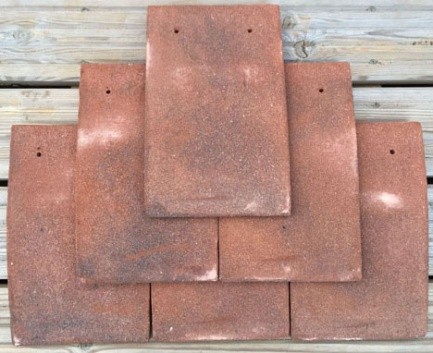
Clayhall Medium Blend - Carefully crafted to replicate all the features of handmade the Clayhall hand crafted range of tiles offers an excellent alternative when budget restrictions are a concern, but without compromising quality or durability.
Clayhall Dark Blend - Quality and durability in a budget clay roof tile. The Clayhall dark blend is sure to turn heads.
Clayhall Red Blend - A beautiful rustic clay roof tile. The Clayhall red blend is a firm favourite with our customers.
Clayhall Hamlet Mix - The Clayhall Hamlet mix is a gorgeous light and sandy looking clay roof tile that is a perennial favourite in the building trade.
Clayhall Birchwood Mix - The Clayhall Birchwood mix offers a gorgeous blend of lighter and darker shades in this diverse clay roof tile. If you are concerned that your roof tiles could look monotonous, the Clayhall Birchwood mix is the clay roof tile to choose.
The Conservation Range of roof tiles
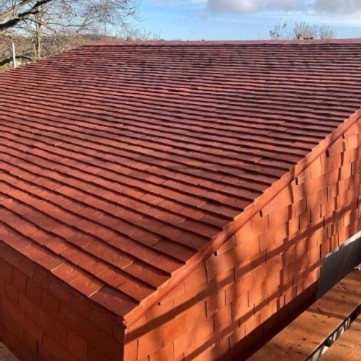
The Conservation range of roof tiles are available in a range of distinctive colours, created by using a very fine sand, The Conservation Weathered; A natural warm tone, achieving an instant mellow and settled look and The Conservation Red; perfect for vertical tiling especially suited for villages and hamlets with olde world vernacular charm.
Manufactured using high quality clay, achieving high strength and durability properties, giving homeowners and contractors peace of mind for many years to come. The conservation range comes with a complete set of associated fittings, including Hog Back Ridge, Half Round Ridge, Bonnet Hips, Valley tiles and External Angles.
The Conservation range of clay roof tiles comes in the following variations:
- Conservation Red
- Conservation Weathered
- Conservation Dark
Conservation Peg Tile
Plain clay roofing tiles laid to a double lap have been used for roof covering in England since before the Norman Conquest and tiles dating back to Roman Times have been discovered under excavation. From the outset clay plain tiles were made incorporating fixing features.
The Classic Edwardian roof tile
The Classic range of plain tiles is one of the finest ranges of clay tiles.
We source only the best raw materials for our craftsman to create beautifully handmade clay tiles of the highest quality and durability.
Tile Fittings available from Heritage Tiles
There are many fittings that are available from us a Heritage Tiles to complete your build to perfection. We stock and supply the following:
- Gable Tile
- Eave Tile
- Baby Porch Ridge
- 90 Degree Ext. Angle
- Universal Bonnet Hip
- Half Round Ridge
- Hogs Back Ridge
- Mono Ridge
- Third Round Ridge
- Universal Valley
- Ornamental Club
- Bat Tile Set
Bat Tiles:
Provide help for our bats with our range of bat friendly roof tiles.
Did you know that all UK bats and their roosts are protected by law? The Wildlife and Countryside Act introduced in 1981, gave legal protection to all bat species and their roosts in England.
Distinct species of bats prefer differing places to roost. The two most usually found species of bat in the UK are the Pipistrelle and Brown Long-Eared Bat. Pipistrelle prefer confined spaces such as under tiles on roofs and hanging spaces. The Brown Long-Eared Bat prefer roof timbers and ridges inside lofts. Heritage Clay Tiles can provide purpose made access points within your roof tiles or ridge tiles. The Bat Tile Set can form part of a mitigation package required by law for existing roosts or as potential access where a roost had not previously been present.
Select a Blend
Getting the right blend for your roofing project can feel daunting, but with our blend generator you can mix and match various blends of tiles to achieve the perfect blend.
Click here to make use of our online tool to choose your own unique blend.
Because our strict quality control provides a consistent tile size you can mix assorted styles and colours of tiles to make your roof unique to you. Please use the tool below to experiment with various blends.
Adjust the sliders to set the ingredients for your desired blend then click on the update mix button.
Alternatively click on any blend or tile to display it.
Whatever type of clay roof tile you want, Heritage Tiles will be able to help.
Victorian Roof Tiles
The Victorian period is synonymous with innovation and build quality. It was a time when things were really made to last. People demanded quality and where prepared to pay that little extra for it.
Fortunately, Heritage Clay Tiles Ltd will not charge a huge sum of money for our Victorian roof tile, even though the quality is absolutely superb. Most people will be able to justify purchasing this top quality roof tile, no matter what their budget.
The Victorian roof tile that is made to last
When you buy our Victorian roof tile, you will be buying into a product with a long and rich heritage. A superb clay roof tile that will endure many years of wear, standing up to the very worst the British weather can throw at them.
The delightful light grey colouring and wonderful texture of the Victorian roof tile will make your property look simply amazing. They will add character to any building project and many years of reliable protection from the elements.
Heritage Clay Tiles Ltd are proud to supply and sell the Victorian roof tile. They are a perennial favourite with our customers simply because they last so long, are a joy to work with and look so good when placed on any roof.
What sets a Victorian roof apart from other properties?
Victorian roofs traditionally look like a very large triangle with the sides made from timber rafters propped up against each other. At the base, the rafter feet are joined together by the ceiling joists, which all rest on the walls below.
In order to prevent the roof slopes from sagging, extra support is often provided by thick timber beams that run from one end of the roof to the other. In some of the larger Victorian properties that have attic rooms, the roofs were built with beams known as queen posts, which are simple constructions of two upright posts with a crossbar for added strength.
If you have a Victorian property and require the very finest handmade clay roof tiles to maintain the true Victorian aesthetic, the Victorian roof tile from Heritage Clay Tiles Ltd is the perfect choice for you.
A little information about London
Early modern history in London
During the Tudor period, the Reformation of the established church produced a gradual shift to Protestantism. Much of the property in London passed from church to private ownership, which quickened trade and business in London. In 1475 the Hanseatic League set up a main trading base of England in London, called the Stalhof or Steelyard. It remained until 1853, when the Hanseatic cities of Lubeck, Bremen and Hamburg sold the property to Southeastern Railway. Woollen cloth was shipped undyed and undressed from 14th and 15th century London to the nearby shores of the Low Countries. The cloth trade was a major source of wealth for the developing city of London.
However, English maritime enterprise hardly reached beyond the seas of northwestern Europe. The commercial route to the Italian peninsula and the Mediterranean Sea was normally through Antwerp and over the Alps; any ships passing through the Strait of Gibraltar to or from England were likely to be Italian or Ragusan. The reopening of the Netherlands to English shipping in January 1565 brought about a sudden flurry of commercial activity for London. The Royal Exchange in London was founded as a direct result of this sudden boost in trade. Mercantilism grew and monopoly traders such as the East India Company were founded as trade expanded to the New World. London became the main North Sea port, with migrants arriving from England and abroad. The population of London rose from about 50,000 in 1530 to about 225,000 in 1605.
Theatre and the arts come to London
The celebrated poet and playwright William Shakespeare and his contemporaries lived in London during the time of English Renaissance theatre. Shakespeare's Globe Theatre was constructed in 1599 in Southwark. Unfortunately, stage performances were stopped in London when Puritan authorities shut down the theatres in the 1640s. The ban on theatre was lifted during the Restoration in 1660, and London's oldest operating theatre, Drury Lane, opened in 1663 in what is now the West End theatre district. Theatre world that was started by the Bard has endured in this part of London to this day.
By the end of the Tudor period in 1603, London was still rather small and self-contained. There was an assassination attempt on James I in Westminster, in the Gunpowder Plot of 5 November 1605. In 1637 the government of Charles I attempted to reform administration in the London area. This called for the Corporation of the city to extend its jurisdiction and administration over expanding areas around the city. Fearing an attempt by the Crown to diminish the Liberties of London, coupled with a lack of interest in administering these additional areas or concern by city guilds of having to share power, caused the Corporation's 'The Great Refusal', a decision which largely continues to account for the unique governmental status of the City of London.
The Civil War, plague, and Great Fire of London
In the English Civil War, the majority of Londoners supported the Parliamentary cause. After an initial advance by the Royalists in 1642, culminating in the battles of Brentford and Turnham Green, London was surrounded by a defensive perimeter wall known as the Lines of Communication. The lines were built by up to 20,000 people and were completed in under two months. The fortifications failed their only test when the New Model Army entered London in 1647, and they were levelled by Parliament the same year.
London was stricken by terrible disease in the early 17th century, which culminated with the Great Plague of 1665 to1666, which killed up to 100,000 people, or a fifth of the population of London. The Great Fire of London broke out in September 1666 in Pudding Lane in the city of London and quickly swept through the wooden buildings. Rebuilding took over a decade and was supervised by Robert Hooke.
World famous architecture in London
In 1710 Christopher Wren's amazing masterpiece St Paul's Cathedral was completed, replacing its medieval predecessor, which burnt down in the Great Fire. The dome of St Paul's dominated the London skyline for centuries, inspiring the artworks and writing of William Blake, with his 1789 poem 'Holy Thursday' referring to 'the high dome of Pauls'. During the Georgian era new districts such as Mayfair were formed in the west; new bridges over the Thames encouraged development in South London. In the east the Port of London expanded downstream. London's development as an international financial centre matured for much of the 18th century.
A new police force for London
During the 18th century London was said to be riddled with crime, and the Bow Street Runners were established in 1750 as a professional police force. This shift toward a dedicated and organised police force was to become the modern-day Metropolitan Police who retain their Peelian Principles, so named after Sir Robert Peel, their founder.
The Nine Peelian Principles the London force follow
- Prevent crime and disorder as an alternative to repression by military force or harsh legal punishment.
- Depend on the London publics approval for the police to fulfil their duties and maintain respect.
- Secure the London publics cooperation in law observance, recognising that willing cooperation reduces the need for force.
- Use minimal physical force, only when persuasion, advice, and warning are insufficient.
- Maintain impartial service to the law, offering courtesy, friendship, and protection to all, regardless of social status.
- Seek public favour through ethical conduct, not by pandering to opinion.
- Recognise that the police are the public, and the public are the police, with officers being full-time members of the London community.
- Adhere strictly to police-executive functions, avoiding usurping judicial powers.
- Measure effectiveness by the absence of crime, not by the number of arrests, emphasising trust and accountability.
Products available from Heritage Clay Tiles Ltd in East Sussex
Clay Roof Tiles in East Sussex
Clayhall Roof Tiles in East Sussex
Conservation Peg Tiles in East Sussex
Conservation Roof Tiles in East Sussex
Edwardian Roof Tiles in East Sussex
Georgian Roof Tiles in East Sussex
Handmade Clay Tiles in East Sussex
Handmade Roof Tiles in East Sussex
High Quality Roof Tiles in East Sussex
Traditional Clay Tiles in East Sussex
Traditional Roof Tiles in East Sussex
Victorian Roof Tiles in East Sussex
Products available from Heritage Clay Tiles Ltd in Essex
Conservation Peg Tiles in Essex
Conservation Roof Tiles in Essex
High Quality Roof Tiles in Essex
Traditional Clay Tiles in Essex
Traditional Roof Tiles in Essex
Products available from Heritage Clay Tiles Ltd in Hampshire
Clayhall Roof Tiles in Hampshire
Conservation Peg Tiles in Hampshire
Conservation Roof Tiles in Hampshire
Edwardian Roof Tiles in Hampshire
Georgian Roof Tiles in Hampshire
Handmade Clay Tiles in Hampshire
Handmade Roof Tiles in Hampshire
High Quality Roof Tiles in Hampshire
Traditional Clay Tiles in Hampshire
Traditional Roof Tiles in Hampshire
Victorian Roof Tiles in Hampshire
Products available from Heritage Clay Tiles Ltd in Hertfordshire
Clay Roof Tiles in Hertfordshire
Clayhall Roof Tiles in Hertfordshire
Conservation Peg Tiles in Hertfordshire
Conservation Roof Tiles in Hertfordshire
Edwardian Roof Tiles in Hertfordshire
Georgian Roof Tiles in Hertfordshire
Handmade Clay Tiles in Hertfordshire
Handmade Roof Tiles in Hertfordshire
High Quality Roof Tiles in Hertfordshire
Traditional Clay Tiles in Hertfordshire
Traditional Roof Tiles in Hertfordshire
Victorian Roof Tiles in Hertfordshire
Products available from Heritage Clay Tiles Ltd in Kent
Conservation Peg Tiles in Kent
Conservation Roof Tiles in Kent
High Quality Roof Tiles in Kent
Traditional Clay Tiles in Kent
Traditional Roof Tiles in Kent
Products available from Heritage Clay Tiles Ltd in London
Conservation Peg Tiles in London
Conservation Roof Tiles in London
Edwardian Roof Tiles in London
High Quality Roof Tiles in London
Traditional Clay Tiles in London
Traditional Roof Tiles in London
Products available from Heritage Clay Tiles Ltd in Surrey
Conservation Peg Tiles in Surrey
Conservation Roof Tiles in Surrey
Edwardian Roof Tiles in Surrey
High Quality Roof Tiles in Surrey
Traditional Clay Tiles in Surrey
Traditional Roof Tiles in Surrey
Victorian Roof Tiles in Surrey
Products available from Heritage Clay Tiles Ltd in West Sussex
Clay Roof Tiles in West Sussex
Clayhall Roof Tiles in West Sussex
Conservation Peg Tiles in West Sussex
Conservation Roof Tiles in West Sussex
Edwardian Roof Tiles in West Sussex
Georgian Roof Tiles in West Sussex
Handmade Clay Tiles in West Sussex
Handmade Roof Tiles in West Sussex
High Quality Roof Tiles in West Sussex
Traditional Clay Tiles in West Sussex
Traditional Roof Tiles in West Sussex
Victorian Roof Tiles in West Sussex
Products available from Heritage Clay Tiles Ltd in Bedfordshire
Clay Roof Tiles in Bedfordshire
Clayhall Roof Tiles in Bedfordshire
Conservation Peg Tiles in Bedfordshire
Conservation Roof Tiles in Bedfordshire
Edwardian Roof Tiles in Bedfordshire
Georgian Roof Tiles in Bedfordshire
Handmade Clay Tiles in Bedfordshire
Handmade Roof Tiles in Bedfordshire
High Quality Roof Tiles in Bedfordshire
Traditional Clay Tiles in Bedfordshire
Products available from Heritage Clay Tiles Ltd in Berkshire
Clayhall Roof Tiles in Berkshire
Conservation Peg Tiles in Berkshire
Conservation Roof Tiles in Berkshire
Edwardian Roof Tiles in Berkshire
Georgian Roof Tiles in Berkshire
Handmade Clay Tiles in Berkshire
Handmade Roof Tiles in Berkshire
High Quality Roof Tiles in Berkshire
Traditional Clay Tiles in Berkshire
Products available from Heritage Clay Tiles Ltd in Buckinghamshire
Clay Roof Tiles in Buckinghamshire
Clayhall Roof Tiles in Buckinghamshire
Conservation Peg Tiles in Buckinghamshire
Conservation Roof Tiles in Buckinghamshire
Edwardian Roof Tiles in Buckinghamshire
Georgian Roof Tiles in Buckinghamshire
Handmade Clay Tiles in Buckinghamshire
Handmade Roof Tiles in Buckinghamshire
High Quality Roof Tiles in Buckinghamshire
Traditional Clay Tiles in Buckinghamshire
Products available from Heritage Clay Tiles Ltd in Cambridgeshire
Clay Roof Tiles in Cambridgeshire
Clayhall Roof Tiles in Cambridgeshire
Conservation Peg Tiles in Cambridgeshire
Conservation Roof Tiles in Cambridgeshire
Edwardian Roof Tiles in Cambridgeshire
Georgian Roof Tiles in Cambridgeshire
Handmade Clay Tiles in Cambridgeshire
Handmade Roof Tiles in Cambridgeshire
High Quality Roof Tiles in Cambridgeshire
Traditional Clay Tiles in Cambridgeshire
Traditional Roof Tiles in Cambridgeshire
Victorian Roof Tiles in Cambridgeshire
Products available from Heritage Clay Tiles Ltd in Oxfordshire
Clay Roof Tiles in Oxfordshire
Clayhall Roof Tiles in Oxfordshire
Conservation Peg Tiles in Oxfordshire
Conservation Roof Tiles in Oxfordshire
Edwardian Roof Tiles in Oxfordshire
Georgian Roof Tiles in Oxfordshire
Handmade Clay Tiles in Oxfordshire
Handmade Roof Tiles in Oxfordshire
High Quality Roof Tiles in Oxfordshire
Traditional Clay Tiles in Oxfordshire
Products available from Heritage Clay Tiles Ltd in Suffolk
Clayhall Roof Tiles in Suffolk
Conservation Peg Tiles in Suffolk
Conservation Roof Tiles in Suffolk
Edwardian Roof Tiles in Suffolk
Georgian Roof Tiles in Suffolk
Handmade Clay Tiles in Suffolk
Handmade Roof Tiles in Suffolk
High Quality Roof Tiles in Suffolk
Traditional Clay Tiles in Suffolk
Traditional Roof Tiles in Suffolk
Victorian Roof Tiles in Suffolk
Further Information
If you would like to know more or are interested in a quote we would be happy to help. Phone us on 01634 471 344, email us at sales@heritagetiles.co.uk and we will be in touch as soon as possible.