
Clay Roof Tiles in Hampshire
Heritage Tiles: Emblematic of the finest craftsmanship
Heritage tiles are the professional roofer's choice for the highest quality clay roof tiles. We pride ourselves in manufacturing, stocking, and delivering the very finest in prestige clay roof tiles.
Heritage Tiles have several tile ranges that satisfy every architectural requirement. Vintage and historic properties right up to modern new builds are covered by the diverse range of clay roof tiles that we stock.
So, whether you are in the building trade, or simply wish to choose your own tiles, Heritage Tiles have the right product for your specific requirements.
What Heritage Tiles have to offer our customers?
- We offer specification and technical solutions to help you achieve the perfect build.
- We also offer expert design advice to all our customers.
- We are happy to engage in site visits with our clients.
- We have stockists and distributors throughout the United Kingdom to ensure that we can provide our expert service to a wider area.
- We can provide estimated quantities from plans supplied by our clients.
- We offer battening plans.
- We can deliver a standard and bespoke colour choice for our clay tile products.
- All our tiles are assessed and approved by Lucideon.
- We provide a nationwide delivery and collection service.
The ranges of clay roof tiles we supply.
The Clayhall Range of roof tiles:
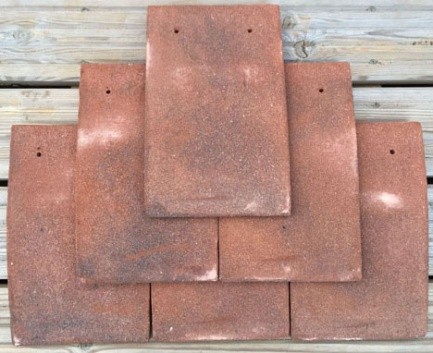
Clayhall Medium Blend - Carefully crafted to replicate all the features of handmade the Clayhall hand crafted range of tiles offers an excellent alternative when budget restrictions are a concern, but without compromising quality or durability.
Clayhall Dark Blend - Quality and durability in a budget clay roof tile. The Clayhall dark blend is sure to turn heads.
Clayhall Red Blend - A beautiful rustic clay roof tile. The Clayhall red blend is a firm favourite with our customers.
Clayhall Hamlet Mix - The Clayhall Hamlet mix is a gorgeous light and sandy looking clay roof tile that is a perennial favourite in the building trade.
Clayhall Birchwood Mix - The Clayhall Birchwood mix offers a gorgeous blend of lighter and darker shades in this diverse clay roof tile. If you are concerned that your roof tiles could look monotonous, the Clayhall Birchwood mix is the clay roof tile to choose.
The Conservation Range of roof tiles
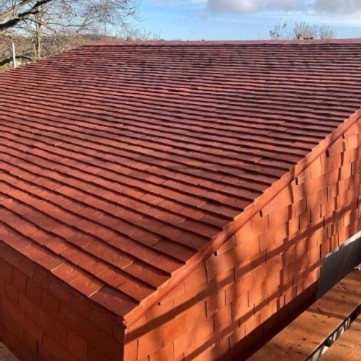
The Conservation range of roof tiles are available in a range of distinctive colours, created by using a very fine sand, The Conservation Weathered; A natural warm tone, achieving an instant mellow and settled look and The Conservation Red; perfect for vertical tiling especially suited for villages and hamlets with olde world vernacular charm.
Manufactured using high quality clay, achieving high strength and durability properties, giving homeowners and contractors peace of mind for many years to come. The conservation range comes with a complete set of associated fittings, including Hog Back Ridge, Half Round Ridge, Bonnet Hips, Valley tiles and External Angles.
The Conservation range of clay roof tiles comes in the following variations:
- Conservation Red
- Conservation Weathered
- Conservation Dark
Conservation Peg Tile
Plain clay roofing tiles laid to a double lap have been used for roof covering in England since before the Norman Conquest and tiles dating back to Roman Times have been discovered under excavation. From the outset clay plain tiles were made incorporating fixing features.
The Classic Edwardian roof tile
The Classic range of plain tiles is one of the finest ranges of clay tiles.
We source only the best raw materials for our craftsman to create beautifully handmade clay tiles of the highest quality and durability.
Tile Fittings available from Heritage Tiles
There are many fittings that are available from us a Heritage Tiles to complete your build to perfection. We stock and supply the following:
- Gable Tile
- Eave Tile
- Baby Porch Ridge
- 90 Degree Ext. Angle
- Universal Bonnet Hip
- Half Round Ridge
- Hogs Back Ridge
- Mono Ridge
- Third Round Ridge
- Universal Valley
- Ornamental Club
- Bat Tile Set
Bat Tiles:
Provide help for our bats with our range of bat friendly roof tiles.
Did you know that all UK bats and their roosts are protected by law? The Wildlife and Countryside Act introduced in 1981, gave legal protection to all bat species and their roosts in England.
Distinct species of bats prefer differing places to roost. The two most usually found species of bat in the UK are the Pipistrelle and Brown Long-Eared Bat. Pipistrelle prefer confined spaces such as under tiles on roofs and hanging spaces. The Brown Long-Eared Bat prefer roof timbers and ridges inside lofts. Heritage Clay Tiles can provide purpose made access points within your roof tiles or ridge tiles. The Bat Tile Set can form part of a mitigation package required by law for existing roosts or as potential access where a roost had not previously been present.
Select a Blend
Getting the right blend for your roofing project can feel daunting, but with our blend generator you can mix and match various blends of tiles to achieve the perfect blend.
Click here to make use of our online tool to choose your own unique blend.
Because our strict quality control provides a consistent tile size you can mix assorted styles and colours of tiles to make your roof unique to you. Please use the tool below to experiment with various blends.
Adjust the sliders to set the ingredients for your desired blend then click on the update mix button.
Alternatively click on any blend or tile to display it.
Whatever type of clay roof tile you want, Heritage Tiles will be able to help.
Clay Roof Tiles
No matter where you live, Heritage Clay Tiles Ltd are the company that can deliver the very finest clay roof tiles to complete your building project.
Our range of clay roof tiles are manufactured in the traditional way but employ modern kiln technology, so you will always have the unique look that only a top quality clay roof tile can deliver.The consistency and quality of manufacture is what we are renowned for, as we never sacrifice quality in anything we produce.
Blending our clay roof tiles using our tile blending tool on our website will enable you to get the perfect blend of texture, colour and shade so that your roofing project will be unique and will most likely win your company fresh orders in recommendations alone.
The sheer quality of our clay roof tiles will impress both builders and home owners alike. This is what happens when you order from the United Kingdoms premium clay roof tile manufacturer and supplier.
We have over fifty years of experience in the roof tiling business, our team of professionals are ready and waiting to help you achieve the perfect results every time, no matter what type of property you have in mind. Why not call us today for your clay roof tiles and other roofing supplies?
A little information about Hampshire
The Roman Era in Hampshire
The Romans invaded Britain again in 43 CE and Hampshire was swiftly incorporated into the Roman province of Britannia. It is believed their political leaders allowed themselves to be incorporated peacefully in order to avoid unnecessary bloodshed. Venta became the capital of the administrative polity of the Belgae, which included most of the county of Hampshire and Wiltshire and reached as far as the town of Bath. Whether the people of Hampshire played any role in Boudicca's rebellion of 60 to 61 is not recorded in any known documentation, but evidence of extensive burning is seen in Winchester dated to around that period of time. For most of the next three hundred years, southern Britain enjoyed relative peace and harmony.
During the later part of the Roman period most towns built defensive walls; a pottery industry based in the New Forest exported items widely across southern Britain. A fortification near Southampton was called Clausentum, part of the Saxon Shore forts, traditionally seen as either defences against maritime raids by Germanic tribes, or as a settlement area of Germanic tribes, which appears to be supported by archaeological finds in and around the Hampshire area. Artefacts of a Germanic style have been found in burial sites, while there is also evidence of the presence of early Saxon settlement in Hampshire and the northern coasts of Gaul around Boulogne-sur-Mer and Bayeux. This could mirror a well-documented practice of deliberately settling Germanic tribes to strengthen the Roman defences.
Ancient Roman roads through Hampshire
Two major Roman roads, Ermin Way and Port Way, cross the north of Hampshire connecting Calleva Atrebatum with Corinium Dobunnorum, which are now known as modern Cirencester, and Old Sarum. Other roads connected Venta Belgarum with Old Sarum, Wickham and Clausentum. A road presumed to diverge from the Chichester to Silchester Way at Wickham connected Noviomagus Reginorum, modern Chichester, with Clausentum.
The Jutes who settled in Hampshire
It is thought that over the following three hundred or so years, there was a considerable influx of Jutes into the Hampshire area. The Jutes were one of the Germanic tribes who settled in Great Britain after the departure of the Romans. According to Bede, they were one of the three most powerful Germanic nations, along with the Angles and the Saxons.
Those who came over to Hampshire were of the three most powerful nations of Germany, namely Saxons, Angles, and Jutes. From the Jutes are descended the people of Kent, and of the Isle of Wight, and those also in the province of the West Saxons who are to this day called Jutes, seated opposite to the Isle of Wight.
The Jutes initially settled in Hampshire under Visigothic authority sometime after 476 AD, forming several distinct folk lands organised around a central geographical feature. Various placenames identify locations as Jutish, including Bishopstoke (Ytingstoc), the River Itchen (Ytene) and the Meon Valley (Ytedene). There in fact appear to be at least two Jutish folk lands in Hampshire: one established along the River Itchen and one along the River Meon. Evidence of an early Germanic settlement has been found at Clausentum, dated to the fifth century and likely the Visigothic centre of power in this part of Hampshire, either independently or in conjunction with powerful Romano-British trading ports. Nevertheless, Visigothic authority waned after 517 A.D and the settlements were gradually encroached upon by South Saxons.
The Saxons in Hampshire
The West Saxons moved south in the late seventh century and incorporated Hampshire into their expanding kingdom. During this period, the administrative region of Hampshire begins to appear.
Wessex, with its capital at Winchester, gradually expanded westwards into Brythonic Dorset and Somerset. A statue in Winchester celebrates the powerful King Alfred the Great, who repulsed the Vikings and stabilised the region, particularly in Hampshire in the ninth century. A celebrated and thoughtful scholar as well as a brave and respected soldier, the Anglo-Saxon Chronicle, a powerful tool in the development of the English identity, was commissioned during his reign. King Alfred proclaimed himself "King of England" in 886 AD; but Athelstan of Wessex did not officially control the whole of England until 927 AD.
Hampshire from the Middle Ages onwards
By the time of the Norman Conquest, London had overtaken Winchester as the largest city in England and after the Norman Conquest, King William I made London his capital. He built huge castles and walls to keep him and his friends safe from the real threat of the angry local population who saw their new monarch as a conquering enemy at first. While the centre of political power moved away from Hampshire, Winchester remained an important city; the proximity of the New Forest to Winchester made it a frequently visited and favourite royal hunting forest; King William Rufus was killed while hunting there in 1100. There were forty-four hundreds, covering over four hundred named places, recorded in the Domesday Book of 1086 which are in present-day Hampshire and part of Sussex. From the 12th century, the ports of Hampshire grew in importance, fuelled by trade with the continent, wool and cloth manufacture in the county, and the fishing industry, and a shipbuilding industry was established. By 1523 at the latest, the population of Southampton had outstripped that of Winchester.
Civil War comes to Hampshire
During the English Civil War there were several violent and bloody skirmishes in Hampshire between the Royalist and Parliamentarian forces. Principal engagements were the Siege of Basing House between 1643 and 1645, and the Battle of Cheriton in 1644; both were clear and also significant Parliamentarian victories. Other battles included the Battle of Alton in 1643, where the commander of the Royalist forces was killed in the pulpit of the parish church, and the Siege of Portsmouth in 1642.
By the middle of the19th century, with the population of Hampshire standing at 219,210, which had actually doubled since the beginning of the century, in more than 86,000 dwellings, agriculture was the main industry, with cereals, peas, hops, honey, sheep and hogs making up the bulk of the trade. Due to Hampshire's long association with pigs and boars, natives of the county have been known as Hampshire hogs since the 18th century. In the eastern part of Hampshire, the principal port was Portsmouth while several ports, including Southampton, with its steam docks, in the western part were incredibly significant for the trade and defence of Hampshire. In 1868, the number of people employed in manufacture exceeded those in agriculture, engaged in silk, paper, sugar and lace industries, ship building, and salt works. Coastal towns in Hampshire engaged in fishing and exporting agricultural produce. Several places were popular for seasonal sea bathing. The ports in Hampshire employed large numbers of workers, both land-based and seagoing; Titanic, lost on her maiden voyage in 1912, was crewed largely by residents of Southampton.
Products available from Heritage Clay Tiles Ltd in East Sussex
Clay Roof Tiles in East Sussex
Clayhall Roof Tiles in East Sussex
Conservation Peg Tiles in East Sussex
Conservation Roof Tiles in East Sussex
Edwardian Roof Tiles in East Sussex
Georgian Roof Tiles in East Sussex
Handmade Clay Tiles in East Sussex
Handmade Roof Tiles in East Sussex
High Quality Roof Tiles in East Sussex
Traditional Clay Tiles in East Sussex
Traditional Roof Tiles in East Sussex
Victorian Roof Tiles in East Sussex
Products available from Heritage Clay Tiles Ltd in Essex
Conservation Peg Tiles in Essex
Conservation Roof Tiles in Essex
High Quality Roof Tiles in Essex
Traditional Clay Tiles in Essex
Traditional Roof Tiles in Essex
Products available from Heritage Clay Tiles Ltd in Hampshire
Clayhall Roof Tiles in Hampshire
Conservation Peg Tiles in Hampshire
Conservation Roof Tiles in Hampshire
Edwardian Roof Tiles in Hampshire
Georgian Roof Tiles in Hampshire
Handmade Clay Tiles in Hampshire
Handmade Roof Tiles in Hampshire
High Quality Roof Tiles in Hampshire
Traditional Clay Tiles in Hampshire
Traditional Roof Tiles in Hampshire
Victorian Roof Tiles in Hampshire
Products available from Heritage Clay Tiles Ltd in Hertfordshire
Clay Roof Tiles in Hertfordshire
Clayhall Roof Tiles in Hertfordshire
Conservation Peg Tiles in Hertfordshire
Conservation Roof Tiles in Hertfordshire
Edwardian Roof Tiles in Hertfordshire
Georgian Roof Tiles in Hertfordshire
Handmade Clay Tiles in Hertfordshire
Handmade Roof Tiles in Hertfordshire
High Quality Roof Tiles in Hertfordshire
Traditional Clay Tiles in Hertfordshire
Traditional Roof Tiles in Hertfordshire
Victorian Roof Tiles in Hertfordshire
Products available from Heritage Clay Tiles Ltd in Kent
Conservation Peg Tiles in Kent
Conservation Roof Tiles in Kent
High Quality Roof Tiles in Kent
Traditional Clay Tiles in Kent
Traditional Roof Tiles in Kent
Products available from Heritage Clay Tiles Ltd in London
Conservation Peg Tiles in London
Conservation Roof Tiles in London
Edwardian Roof Tiles in London
High Quality Roof Tiles in London
Traditional Clay Tiles in London
Traditional Roof Tiles in London
Victorian Roof Tiles in London
Products available from Heritage Clay Tiles Ltd in Surrey
Conservation Peg Tiles in Surrey
Conservation Roof Tiles in Surrey
Edwardian Roof Tiles in Surrey
High Quality Roof Tiles in Surrey
Traditional Clay Tiles in Surrey
Traditional Roof Tiles in Surrey
Victorian Roof Tiles in Surrey
Products available from Heritage Clay Tiles Ltd in West Sussex
Clay Roof Tiles in West Sussex
Clayhall Roof Tiles in West Sussex
Conservation Peg Tiles in West Sussex
Conservation Roof Tiles in West Sussex
Edwardian Roof Tiles in West Sussex
Georgian Roof Tiles in West Sussex
Handmade Clay Tiles in West Sussex
Handmade Roof Tiles in West Sussex
High Quality Roof Tiles in West Sussex
Traditional Clay Tiles in West Sussex
Traditional Roof Tiles in West Sussex
Victorian Roof Tiles in West Sussex
Products available from Heritage Clay Tiles Ltd in Bedfordshire
Clay Roof Tiles in Bedfordshire
Clayhall Roof Tiles in Bedfordshire
Conservation Peg Tiles in Bedfordshire
Conservation Roof Tiles in Bedfordshire
Edwardian Roof Tiles in Bedfordshire
Georgian Roof Tiles in Bedfordshire
Handmade Clay Tiles in Bedfordshire
Handmade Roof Tiles in Bedfordshire
High Quality Roof Tiles in Bedfordshire
Traditional Clay Tiles in Bedfordshire
Products available from Heritage Clay Tiles Ltd in Berkshire
Clayhall Roof Tiles in Berkshire
Conservation Peg Tiles in Berkshire
Conservation Roof Tiles in Berkshire
Edwardian Roof Tiles in Berkshire
Georgian Roof Tiles in Berkshire
Handmade Clay Tiles in Berkshire
Handmade Roof Tiles in Berkshire
High Quality Roof Tiles in Berkshire
Traditional Clay Tiles in Berkshire
Products available from Heritage Clay Tiles Ltd in Buckinghamshire
Clay Roof Tiles in Buckinghamshire
Clayhall Roof Tiles in Buckinghamshire
Conservation Peg Tiles in Buckinghamshire
Conservation Roof Tiles in Buckinghamshire
Edwardian Roof Tiles in Buckinghamshire
Georgian Roof Tiles in Buckinghamshire
Handmade Clay Tiles in Buckinghamshire
Handmade Roof Tiles in Buckinghamshire
High Quality Roof Tiles in Buckinghamshire
Traditional Clay Tiles in Buckinghamshire
Products available from Heritage Clay Tiles Ltd in Cambridgeshire
Clay Roof Tiles in Cambridgeshire
Clayhall Roof Tiles in Cambridgeshire
Conservation Peg Tiles in Cambridgeshire
Conservation Roof Tiles in Cambridgeshire
Edwardian Roof Tiles in Cambridgeshire
Georgian Roof Tiles in Cambridgeshire
Handmade Clay Tiles in Cambridgeshire
Handmade Roof Tiles in Cambridgeshire
High Quality Roof Tiles in Cambridgeshire
Traditional Clay Tiles in Cambridgeshire
Traditional Roof Tiles in Cambridgeshire
Victorian Roof Tiles in Cambridgeshire
Products available from Heritage Clay Tiles Ltd in Oxfordshire
Clay Roof Tiles in Oxfordshire
Clayhall Roof Tiles in Oxfordshire
Conservation Peg Tiles in Oxfordshire
Conservation Roof Tiles in Oxfordshire
Edwardian Roof Tiles in Oxfordshire
Georgian Roof Tiles in Oxfordshire
Handmade Clay Tiles in Oxfordshire
Handmade Roof Tiles in Oxfordshire
High Quality Roof Tiles in Oxfordshire
Traditional Clay Tiles in Oxfordshire
Products available from Heritage Clay Tiles Ltd in Suffolk
Clayhall Roof Tiles in Suffolk
Conservation Peg Tiles in Suffolk
Conservation Roof Tiles in Suffolk
Edwardian Roof Tiles in Suffolk
Georgian Roof Tiles in Suffolk
Handmade Clay Tiles in Suffolk
Handmade Roof Tiles in Suffolk
High Quality Roof Tiles in Suffolk
Traditional Clay Tiles in Suffolk
Traditional Roof Tiles in Suffolk
Victorian Roof Tiles in Suffolk
Further Information
If you would like to know more or are interested in a quote we would be happy to help. Phone us on 01634 471 344, email us at sales@heritagetiles.co.uk and we will be in touch as soon as possible.